Showing posts with label Fish. Show all posts

Sunday, 21 June 2015

Auckland - where there really is plenty to do!

It’s not only the small towns that are known for something distinctive. NZ cities also have their unique claim to fame. Auckland is known as 'The City of Sails' for the huge number of boats often seen on the harbour. Auckland has a large, sheltered harbour with small islands dotted around. There are passenger and car ferries which take you to most of the islands. Or you could find yourself on someone’s private boat island hopping and getting up close to the action during events on the harbour.

Mum and Dad have a boat so we went out with them quite a few times. We lost the anchor the first time we went out fishing. Which meant we had to go back the next day to dive and look for it. 
Out with mum and dad on their boat
No luck with our search and recovery (that day or the next), but we did see loads of nudibranchs (colourful sea slugs) we hadn’t seen before. And they were enormous! None of this looking for 3mm long nudi’s like we were in Thailand! We had 1 metre long kingfish circling us and plenty of scorpionfish to watch out for too. Good to be back in NZ waters although a tad colder than the tropical waters I’ve become accustomed to!
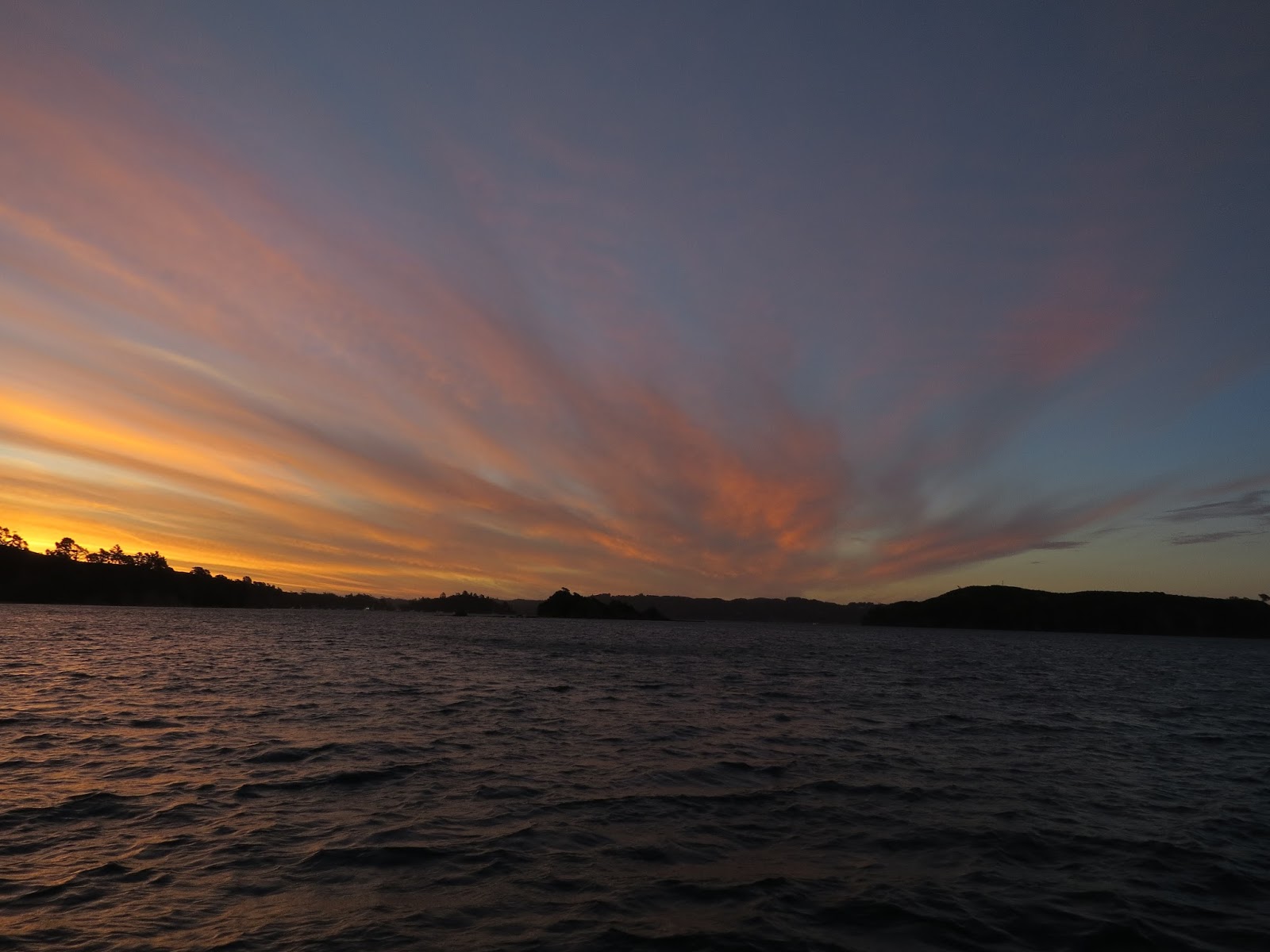
And the evening sunsets are stunning on the water
The last Monday in January is Auckland Anniversary Day. Every year, they have a regatta on the harbour with all sorts of races, events and old sailing ships to watch. 

We started off the day with a trek up Rangitoto, a dormant volcano in the middle of the harbour. It last erupted about 250 years ago and has been pretty quiet since then (thank goodness!) I thought I was along for a gentle stroll to the top. But with Mike (my brother) leading the way, it was more like a military march up! The view is well worth the hike up (only about 40 minutes from the ferry wharf or about 75 mins from Islington Bay). Native birds hop around your feet, there are bunkers from WW2 set into the cliff to explore and plenty of places to sit and enjoy the view. 
Another stunning view of Auckland from the top of Rangitoto
Native waxeyes aren't scared to get close
Mike, me, Kris and Uncle Brian at the top
Then it was back to the boat and off to see the old ships racing. They really are spectacular to watch and with a good, stiff breeze blowing, they were getting along very nicely. Unfortunately we missed the tug boats racing - which I think would have been pretty funny to see!
A cruisy day for this old timer
But a bit more action on board here
Our final activity of the day was a spot of waterskiing. Mike set the standard getting up on his first go. I followed suit, even managing a short stint on one ski. Then it was Kris’ turn (who had never skied before). After a few sideways splats and a bit of help from Mike, he managed to stand on his skis and make a few laps of the bay.
Mike setting the standard
I've still got it!
Kris' first attempt
We've all been there!
Got the feel for it now
About 1.5 hours drive north of Auckland is Goat Island, the site of NZ’s first marine reserve. It became a reserve in 1975 and since then, fish populations (and fish sizes) have increased dramatically in the area. In summer, Goat Island is incredibly popular with people turning up to snorkel, dive or watch the fish from the surface in a glass bottom boat. 
Goat Island is packed already, and only about 1030am
Kris, Mike and I decided to do a dive there one hot, summer day. Even though it was shallow (max depth about 12 m), we saw more than enough to keep us all interested. About 8 eagle rays (you’d be lucky to see 1 in Thailand), enormous stingrays (3m from wingtip to wingtip), plenty of nudibranchs, huge snapper hanging just above our heads, crayfish, kina (sea urchins), parore, kelpfish and plenty of other NZ species Kris has never seen. It really highlighted how a marine reserve does help fish populations recover and increase the overall biomass of the area. 
Lunch after a dive
Not so good was how many fish hung around waiting to be fed. In the past, people would bring frozen peas and bread to feed the fish. It’s not encouraged any more although it is taking time for the message to get through - to people and the fish!

If you’re more of an indoor person but would still like to see some of the underwater world, Kelly Tarlton’s Underwater World is worth a visit. Kelly Tarlton was an explorer, a creator and a treasure hunter exploring several shipwrecks and recovering their treasure. He developed the first dome aquarium where you walk through a tunnel under the fish. Sadly, Kelly Tarlton died just 7 weeks after his dream aquarium opened in 1985.
Under the original aquarium dome
Kelly Tarlton's display mainly local species of marine life in the aquarium. It's lucky both Kris and I enjoy the marine life as we spent hours here watching fish swimming back and forth and reading just about every sign we came to!
Translucent jellyfish floating around
Stingray - about the same size as the ones we saw diving
NZ Kelp fish
Just a hermit crab saying hello
Native long-fin freshwater eel
Rare NZ Spiny Sea Dragons
Alongside the local species there are several species of brightly coloured, tropical fish that bring smiles of delight to kids (young and old). 
A mandarin fish - I'd love to see one of these in the wild
Anemone fish - super cute in huge schools
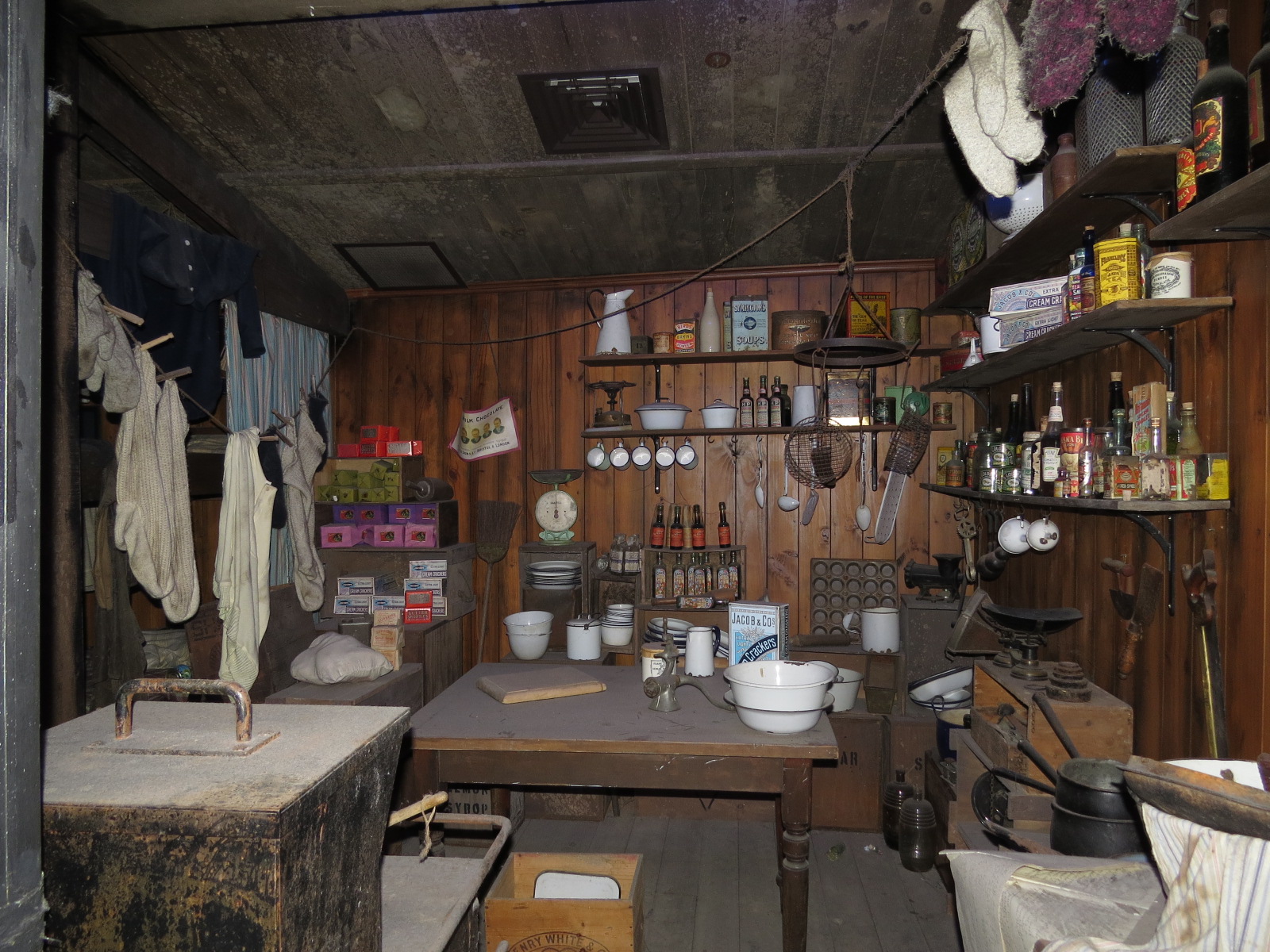
Kelly Tarlton's also has an Antarctic section. Beginning with a walk through Scott’s Hut, a replica of explorer Captain Robert Scott's hut in Antarctica, you then come to the penguins. 
Complete with old tins of food, radios, scientific equipment and a piano!
I worked here for 2 years and it was delightful to see the birds that I grew to love again. The larger king penguins were sitting on eggs, while the smaller gentoos looked miserable going through their annual moult. They still moved with the same grace underwater and stumbling waddle on land and had me reminiscing about my time there.
An old friend coming to say hello perhaps?
Miserable gentoos moulting
King penguin sitting on an egg with her mate beside
So as you can see, 2 blog posts worth of 'nothing to do in Auckland'. And this really is only a small selection of all that the largest city in NZ offers you. I really did enjoy living in Auckland and it was fun to be back as a tourist again. Happy sightseeing and hope you enjoy it too!

Tuesday, 21 October 2014

Beyond Oceans Media - the Official Launch

Well, it might seem like all I’ve done in the last 5 months is trip around Sweden, explore all the sights, swim in lakes and then get married. And yes, I have spent a lot of time doing all those things. However, there has been something else keeping Kristian and I busy more recently.

BEYOND OCEANS MEDIA

We’ve started up a videography and stock footage business called Beyond Oceans Media. Our website is beyondoceans.tv and (of course) we are on Facebook


Our logo
Kristian is an excellent underwater videographer and has been producing high quality videos for dive trips, dive businesses and other above water tourism companies for the last 5 years. I love writing and speaking and finding fun and creative ways to teach people, especially about the ocean. We’ve found our individual passions complement each other well. And as we are both keen divers and photographers, this business has been our way to create a life and income doing what we love.


We’ve added narratives to some of Kristian’s existing footage, made some new marketing videos for tourism companies in Sweden, and even won a competition promoting diving in cold Scandinavian waters. You can check out some of our videos on our youtube channel.
Video for a canal boat tourist company in Sweden
Gullmarshfjorden - the cold Swedish fjord we promoted in our competition video
...and a cool place to get stunning morning and evening pics
DIVE GUIDES

The main project we’ve been working on the last few months has been creating video dive guides. Paperback dive guide books (similar to Lonely Planet guide books) are common and usually contain maps of dive sites, information about depths and currents in the area and marine life you can expect to see. 

Our dive guides are a bit different. They combine underwater video footage of each dive site with voice-over narration so you can actually see what the sites look like. We also have our own dive site maps, interesting facts about some of the marine life commonly seen at the site and tips about the typical conditions you can expect. 
Our dive site maps
In our 'recording studio'
If you are heading to southern Thailand and are considering going out to the Similan and Surin Islands, then take a look at our free dive guide to Anita’s Reef, one of the commonly dived sites.


Screenshot of what each dive site guide looks like
We also have dive guides for other popular Similan/ Surin Island dive sites available for purchase as a package. The dive sites are Richelieu Rock, Koh Bon ridge, Koh Tachai Pinnacle, Elephant Head Rock and West of Eden. Just drop us an email and let us know what you are interested in.
Some of the other dive sites guides
OUR LATEST PROJECT

We are currently on the island of Bali in Indonesia, diving and filming along the north-east coast at Tulamben. There are plenty of great dive sites the entire length of the bay, and most are easily reached from the shore. 
Harlequin shrimps found on Suriya muck dive
We will have a dive guide of the main dive sites available shortly, as well as a short documentary about the USAT Liberty - a 120m long wreck that rests in the bay. Keep an eye on our website and Facebook page for updates!
Tulamben Bay - walk into the sea from the shore to some amazing dive sites
Gurung Agung, the dormant volcano near Tulamben

Monday, 15 September 2014

Naked men, fermented fish and frogs

Sitting in a hot, wooden room with a naked, beer drinking, male stranger is not something I expected to do when I first came to Sweden. 

Thankfully, Bjorn walked into the sauna first and warned me so I managed to miss that experience. However, once said male stranger had consumed his beer, covered his nakedness and vacated the room (30 minutes later), I was free to experience a sauna - Swedish style.
The sauna room
It’s pretty simple really. Light a fire in the corner and keep it stoked with logs. Throw a bit of water on the coals occasionally to keep the humidity up. When you can’t think straight, walk outside and jump into an icy cold river. Repeat.


The icy cold river with mist just starting to appear
Imagine going from 40 degree super-dry heat to suddenly being plunged into 6 degree flowing water. I chickened out the first time and only went up to my knees in the river. But needing to experience the tradition completely, after warming up a second time, I jumped right in. 
Halfway in the first time
Under completely this time
My skin instantly started prickling and tingling everywhere. My brain went into hyperdrive. My eyes focused on a single object - the ladder out. My heart rate went up to 350 beats per minute…or maybe it dropped to 15 beats per minute. I don't know. I was instantly addicted! In search of a repeat of the hit, I jumped between the steamy sauna and the freezing river a couple more times.
After the hit
Fikka is a very important part of Swedish culture and one of my favourite things. If you go to someone’s place, it’s a matter of minutes before you’re offered coffee and usually some sort of cake, bread or sweets. The coffee comes predominantly in one form - strong and black. (I did choke down one cup of the brew and stayed awake for the next 24 hours. Now I ask for hot water and milk and mix the 3 liquids in equal quantities). 
Fikka can include ice-cream too!
Fikka is as much about chatting as it is eating and drinking and it’s easy to sit down for an hour simply enjoying the time with friends. And you can have fikka anytime, anywhere. If we’re going on a long drive, we often take a thermos of coffee (plus hot water and milk) and something to munch on, and stop at one of the many lakes or rest areas for a break. 
Fikka at a bird nature reserve
Surströmming is not for the faint hearted or for anyone with an oversensitive sense of smell. Everything you have seen or heard about how putrid the smell and taste of this fish is, falls way short. All those youtube videos of people vomiting when a can is cracked open are for real. 

Bjorn arranged for a surströmming party to allow me (and 4 Swedish friends) a chance to experience this tradition. I knew I had every reason to be concerned when I first saw the can. It was bulging, so there had to be some serious chemical reactions going on inside. As soon as the can was pierced, liquid shot a metre into the air and a strange rancid odour filled the air. Mikael and I instantly started gagging, the others weren’t far behind. And the smell didn’t go away! Even the cat had more sense than to get too close.
The bulging tin
Stand well clear when opening
I had to question if this really was fit for human consumption
It doesn't even look appealing
The cat actually looked scared!
This fish has the ability to overwhelm and stick to anything it comes into contact with. A minuscule portion wrapped in potato, creme fraiche and bread was enough to taint the other flavours and ruin normal food. We even washed all our clothes when we got home as the smell of surströmming seemed to have stuck to our clothes. I can tick that one off the list but will be happy if I never have to smell it again!

Sweden is a country with around 97,000 lakes. So it makes sense that swimming is a popular summer time activity. The lakes are beautiful to swim in. The fresh water is so refreshing and the only place for a ‘shower’ when you’re out on a camping or boating trip. We often go snorkelling and watch pike hang motionless in the grass or perch that zap around just out of reach. 


Baby pike (about 5cm long)
Stripy perch with bright orange fins
Everyone seems to get changed in and out of their bathing costumes under a towel on the beach. It took me a while to get used to this, even longer to figure out how to get changed without flashing random strangers. I nearly have the hang of it…nearly.
One of the smaller lakes...at midnight
I reasoned that with so many lakes around, it should be easy to swim in at least 15 different lakes. While I went swimming most days over summer, it was quite late in the season when I finally made number 15. And while it was a lovely, sunny day, the water was only about 17 degrees...
Finally, lake #15!
Midsummers is one day of the year the Swedes really let their hair down. It is celebrated on the Friday nearest the longest day of the year and is to welcome summer and the season of fertility. The tradition states that you collect branches, leaves and wild flowers, construct a maypole and then dance around it singing songs. I personally think this festival takes the award for the quirkiest event I’ve experienced in the Swedish calendar. 

Wild flowers collected for the maypole
Construction begins
Everyone gets involved

Posing for pics


The frog song is the silliest and most well known song of the midsummer festival. We sang the nonsense song about a små grodorna (a small frog) that has no ears or tail and jumped around the maypole with our hands flapping behind us like a tail. 


Our completed midsummers maypole
After midsummers, wild berry picking trips to the forest begin. (This is where allemansrätten is fantastic as you can pick berries almost anywhere). The berry picking season starts with cloudberries (hjortron). These orange-yellow cloud-shaped berries grow in wet, swampy areas and can be hard to find. They have an exquisite taste, like nothing I’ve ever tasted before and go perfectly with wine and cheese.

Wild, swampy areas where you hunt cloudberries
Cloudberries ripening
Best way to eat cloudberry jam
Raspberries (hallon) ripen next. These are a little trickier to pick because of the spikes on the bushes. For me, it’s a small price to pay for being able to eat unlimited raspberries!

Blueberries are next in line. You can pick these by hand or use a berry picker. This contraption allows you to pick lots of berries at once meaning you can easily pick a couple of litres a very short time. And finally, bright red lingon berries are ready. Like the blueberries, these can be picked quickly with a berry picker.
Picking blueberries with the berry picker
Sorting blueberries is not so much fun
We simply freeze the fresh berries and either defrost a few for breakfast each morning or make them into jam. It’s been such a novelty for me to be able to eat as many blueberries as I like and these wild ones have so much more flavour than the farmed variety.

Towards the end of summer, mushrooms begin to sprout up everywhere. Kanterell’s are everyones favourite and it can be a race to get to the best spots to pick them first. And they are so simple to cook. A cast iron frying pan, a lot of butter, splashes of pepper and you’re done. There are so many different species of mushrooms and toadstools growing. A few are edible but many are not, and every year people end up in hospital having mixed up some of the edible/inedible mushrooms. 
They look beautiful, but you can't eat these...
...or these...
...or even these...
So there’s a few of the Swedish traditions and events I’ve experienced in the short time I’ve been here. They have enriched my time here and I've had so much fun participating. I’m really looking forward to spending a winter here and seeing what events pop up that have to be tried at least once (anyone for ice swimming???)