Sunday, 16 June 2013

How to tell soccer teams apart...without coloured jerseys

I've been going along to an aerobics class a few nights a week. It was set up by Atoll Volunteers for the local ladies and is still going strong.

Jewey, one of the local lady's has learned some routines and circuits and happily puts us through our paces. I thought I was fit. But after doing circuits of 8-10 exercises for 1 minute each exercise, repeated 3 times, I'm naffed! I figure my abs, arms and legs will never be the same again...not that there's anything wrong with that!

And while we exercise, there is plenty of laughter and gossip going on, as often happens when you get a bunch of ladies together. I don't understand much of what is said yet, but I still feel included in it all.

I did get told off (nicely) on my first night. The lights had been dimmed and we were lying on our backs. I thought it was a chance to sleep and so drifted off into my happy place. I came back to the room with everyone laughing at me...I was meant to be stretching! Will definitely have to learn a bit more of the language.

If anyone is a fitness or aerobics instructor and keen on coming over and volunteering for any length of time, I know the ladies would love to have you. Think about it!

Soccer is the main sport the boys play here (so any budding soccer coaches would have an endless line of super keen boys - and the odd girl - to train!)
Every evening about 5pm, games start up on all the 'fields'. They're not the green, grassy fields either. These fields are consolidated coral and so sliding tackles are pretty rare! 
Just outside our front door are a couple of fields where the teenagers and young boys play. Its fascinating to watch. There are no fixed boundaries. Play stops when a goal is scored or when the ball is kicked miles away. And they run continually. No wonder they are all so slim and fit looking!

Two minutes away from home is the full size field where the older guys play. It's almost as if the guys transition from field to field as their skills improve. The guys have fantastic ball skills. Passing, dribbling, headers, tricky passes and feints, tackling without doing anyone damage - I quite enjoy watching it (which says a lot as I really don't like watching sport usually!)

And at all levels, you can tell who is on which team not by coloured jerseys, but by guys with shirts vs guys with no shirts!
Involving myself in all these activities is just another way to get to know people, to fit into the local community and to take opportunities to practice the language more! I've also realised I spent a lot of time at home when I was in NZ and I didn't get into local sports teams or events as much as I could have. Nothing like a whole new environment to help me see this!!!


Marine volunteer work...I have been working!

It's been 3 weeks since I arrived on Naifaru and I still haven't let you in on the work I've been doing! I know all my posts so far have been about the fun trips and events on the island, but believe me, I have been working as well!


I signed up to the marine programme here for a couple of reasons. One is I wanted to get back into the subjects I studies at uni. And the other is I've loved all the time I've spent out diving, fishing and boating in the last few years and decided to see what it would be like to work in an area I loved to do for fun.


The marine programme here is still quite new and
Main marine centre building
construction has been underway for the last few months to build Atoll Volunteer's marine centre.

Turtle enclosure under construction
The centre will be the hub for all of Atoll Volunteer's marine programmes as well as the site of several tanks for rehabilitating sick and injured turtles. I've been helping Tess (the resident marine biologist) set up individual programmes basically from scratch. 


First up is the turtle rehabilitation and conservation programme.
Turtles at Felivaru
Turtle and egg poaching is still common here, and sick or injured turtles are occasionally found around the islands or pulled in by fishermen in their nets and lines. Our programme will provide a safe place for turtles to rehabilitate and recover before being released back into the wild.


Researching turtle biology and rehab, as well as going through husbandry manuals from other rehab centres has taken up a big chunk of my time. I've got the first draft of a husbandry manual together and now it's double checking the manual against best practice elsewhere and setting up the systems to make it happen (checklists, buying equipment, training programmes for other volunteers and staff etc...)


Maldivian anemone fish
I saw my first green turtle on a dive yesterday at Kuredu Island! Such a buzz! It was amazing to be so close to it and see how graceful it was swimming along. It is cool to be able to do something practical to ensure they will be around for a long time to come.


Galaxia
Next up is a coral survey and gardening programme. This programme will be in 2 parts. Firstly, ongoing baseline measurements and diversity monitoring of coral reefs around Naifaru (and possibly other islands) will begin, followed by setting up coral gardens and monitoring their development and growth.


Tess has been teaching me coral identification with theory lessons followed by a snorkel to reinforce the learning. I have about 20 genus' sorted, only 52,000 or so to go! And I spent a good part of my scuba dive yesterday naming the coral as I swam along (I had to laugh when I realised what I was doing!)


Physogyra


While the marine centre is still not officially open, we have already held one event here - a tree planting afternoon for World Environment Day. Students from the nature class at the local high school came along and helped Atoll Volunteers and Naifaru Juvenile staff plant 20 coconut trees and about 30 other trees around the centre. Now, I'm out watering them every day...except when thunderstorms come along!
Kids tree planting

Weekly beach clean ups are also held around the marine centre. There are a couple of sections of beach with pristine white sand near the centre that have loads of rubbish wash up on them. Cleaning up these beaches is our way of doing something practical about the marine pollution here and it means we have a gorgeous beach right outside our front door to enjoy!

Well, there's a brief overview of what I've been up to so far. Let me know if there is a particular programme or area you would like to know more about and I promise to try and update you a bit more regularly in the future!


How we get to the office

Tuesday, 4 June 2013

Thuderstorms, smoking education and another picnic day

Thundery skies
There's been a couple of storms come through the last two days. Torrential downpours, lightening and grey milky puddles that cover large sections of the streets for days.

I was woken several times during the night. You know when you're half asleep and your mind plays all sorts of games. Well I was imagining the island was being swamped by the sheer volume of rain bucketing down from the sky and I was going to be left swimming for days (moya!)

Getting ready to leave
We were supposed to be heading off on a picnic today. But based on my crazy dreams and the dark threatening clouds, I had serious doubts if it would go ahead. It did though. 25 people and a whole raft of food were loaded onto a dhoni and we headed out to Vavvaru Island.
The main reason for the picnic was to teach a bunch of the young guys on the island about the dangers and downfalls of smoking. Naifaru Juvenile runs a number of smoking and drug education programmes. They believe it is better to get the kids out on a picnic for a day, play a bunch of games, have some fun and run the education talks outside, rather than having them sit in a classroom for hours.


At Vavvaru, everything was ferried to shore on the boys heads! Within a few moments, we were sitting down to a traditional Maldivian breakfast of potato curry with tuna and rotti. The ladies are amazing verimeehaa kakkaa (master chefs) and pulled out enough food to feed armies of people!
Naasha feeding the troups
(I am really starting to get used to all the curries and so enjoying them! Blog post on food to come...)


Naoko
The education talks started (in dhevehi) so Tess, Cara and I went for our first swim of the day. We ended up playing games in the water for over an hour with Naoko, the 6 year old son of Natto (one of guys who started up Juvenile). Man that boy can talk! He speaks fantastic, clear English and (like any kid) has a gift of wrapping us around his finger and getting us to do whatever he asks.
Tess playing catch with Naoko


A wander round the island, a chat with Natto and then it was time for a treasure hunt.  We joined in this time, even though the clues were in dhevehi. I had such a fun time running around the island, following clues to sites where ghosts were sighted and smoke signals were made and looking for the next marker as the boys translated the clues for me. Our prize was a box of rolled chocolate wafers and the dubious honour of doing a role-play drama, acting out how easy it can be to get into smoking.
Treasure hunt prize


Dodgeball!
Lunch came and went, and then a game of dodgeball on the beach started up. Such a good way to shake down lunch! Another torrential downpour did nothing to dampen the competitiveness and liveliness of the game, it simply kept us all cooler.
Dodgeball!!
Tess and I headed out snorkelling while another lecture was on. So exciting, the marine life is so abundant around the coral reefs - I love it! Out on the dropoff, we saw a massive Napoleon Wrasse, huge schools of unicorn and surgeon fish and hundreds of tiny yellow fish that chased the bubbles from our fins. 
Hanging out for an avo swim
Back on dry land, we joined in some more silly competitions and games. Who could maintain eye contact the longest, dancing while maintaining eye contact (not as easy as you might imagine!) and showing off who had the best dance moves (learning to dance is something else I have to do before I leave!)
The team who organised the day (Natto crouched at front)

A second lunch followed and then it was time to pack up and leave. Just like when we arrived, everything had to be ferried out to the boat on our heads. Fine if you're tall, a little harder for the rest of us. Especially since the wind and waves had picked up and the boat was anchored out deeper...

I was completely soaked through and weary after an action-packed day in the sun (and rain), yet I felt fantastic. I had met some more people, got to know others a little better, learnt a few new words and survived several downpours without melting. 

It was a really cool day. I saw people who cared enough for the future of their young people to get out and do something positive with them. I saw most young people enthusiastically getting involved in all the lectures, activities and games. I saw people helping each other out, often without having to be asked. And I saw a willingness to quickly extend the circle of friends to include relative strangers. 

I may not have not have learned about the dangers of smoking today, but I learned plenty other lessons to carry on in my life.
Deciphering treasure hunting clues


Lining up for food!

Sunday, 2 June 2013

Tuna and turtles on Felivaru

Felivaru is 2 islands over from Naifaru and is the site of an industrial tuna canning factory. We got about halfway there when the dhoni spluttered and stalled. Nothing mechanically wrong, simply out of diesel! A quick phone call, a bit of a wait and then another boat showed up to rescue us.


We were spoiled - lunch on arrival with tuna done 3 different ways. A tour around the island and canning factory and a look at the baby turtles they are rearing! 

The factory on Felivaru processes around 15 tonnes of mainly skippy and yellowfin tuna every day.
Skippies
Well down on the 50 odd tonnes they used to process each day decades ago but such is the cost of overfishing. Most of the tuna today is destined for Europe and the UK and the type (or types) of tuna in each can is made up depending on what is asked for.


A fishing boat had just arrived and the crew unloaded their haul by hand. Throughout the factory, while there are conveyors, can-making machines, sorting and automatic labelling machines, many of the processes are also labour intensive. It's so different from what I'm used to, but it provides much needed work for the people on nearby islands and atolls. 

We jumped into one of the chillers that held 250 tonnes of fish! It was a balmy -20 degrees complete with stalactites, clumps of ice falling from the ceiling and a skating rink on the floor (reminded me of my penguin- keeping days).

Workers who live on Naifaru catch the ferry home each night, while those who come from islands and atolls further away live on Felivaru for several days or weeks before returning home.
Housing for people who stay on Felivaru


The turtles they have were about 1 month old and were so cute! Some were super active and flew around the tank playing dodgems with the others. Some were happy tucking their flippers onto their backs and lazily floating around. While others dived underwater surfacing under another turtle and knocking them away. Much like a bunch of 5 year olds playing!
We are setting up a turtle monitoring, rehab and conservation programme on Naifaru. This trip was a chance for us to see what Felivaru does and to discuss how we could work together and help each other out.


 The beaches on the island have the pure white, soft sand you see in all the Maldives photos...and it's where turtles come to nest! No turtles this afternoon.
But we did see lots of tiny, translucent black tip reef sharks swimming back and forth in ankle deep water. Small, browny stingrays were basking in the shallows too and neither of them seemed to mind when we waded out to see them better.

There are other income-gathering activities on the island too. Fish guts are munched up, dried and turned into garden fertiliser. Coconut husks are mulched for gardening too. And a herd of goats, a flock of chickens and a couple of cows produce milk and eggs which are sold in the islands store.

The other mammals living on the island are huge fruit bats. They were flying from tree to tree and the way they swooped around made me think of Batman!

We caught the ferry back - thankfully this time it was an uneventful and smooth trip home!
Waiting to go

Wandering around Felivaru

Heading to turtle beach


Friday, 31 May 2013

Clothes day...kids in costumes

I had barely had time to drop my bag and change my clothes after I arrived on Naifaru when it was off to clothes day. A family festival where the kids get dressed up in all sorts of costumes.


Little red riding hood, tigers, princesses, mermaids, soldiers, fairies, robin hood, builders. you name it, they had a costume for it! The girls had their hair tied up in elaborate dos or hidden under long, flowing wigs. The boys have theirs slicked back into mohawks and spiky styles. The girls faces are made up with beautiful colours while boys sport aviator sunnies and act oh so suave.

There was even a catwalk for the kids to show off and strut their stuff with proud parents standing attentively at the end snapping photo after photo.
I have never seen so many cute kids in one place!

The next day, we saw the kids dressed up in their costumes at preschool. Some looked slightly disheveled as if they'd slept in their beautiful costumes all night. Others - like the tigers - appeared to have had their faces repainted and looked as fresh as ever.


Thursday, 30 May 2013

Bikini day on Vayva Island

The one day of the week where we get to strip off all the layers and run around in a bikini (the girls that is!)

Juvenile has a dhoni and a few of the local boys come along to crew and keep an eye on us while we snorkel. The dhoni is started like you would a really old car...with a crank. Chey-lo jumped into the engine bay and cranked the handle a few times before the engine spluttered and roared to life.

Casting off and getting out of the harbour is an experience in itself. All the boats are lined up side by side, bows into the wharf. Ropes and anchors are tied off to the wharf, to neighbouring dhonis and criss-crossing over each other out the back. So to cast off and navigate the myriad of ropes is amusing to watch to say the least. Back and forwards, pulling on anchor ropes, pushing off other dhonis and Patchi jumping in with a mask and snorkel to free ropes from around the prop is all normal.


As we headed out of the harbour, a couple more ropes are stretched out for us to cross. No matter, Kale puts the boat in neutral, we glide across the ropes, the engine is put back in forward gear and we're off again. The hull has a smooth keel that begins at the bow and gradually gets deeper so the prop is protected. Ropes slide down the keel and out the back without getting stuck. Practical and simple.


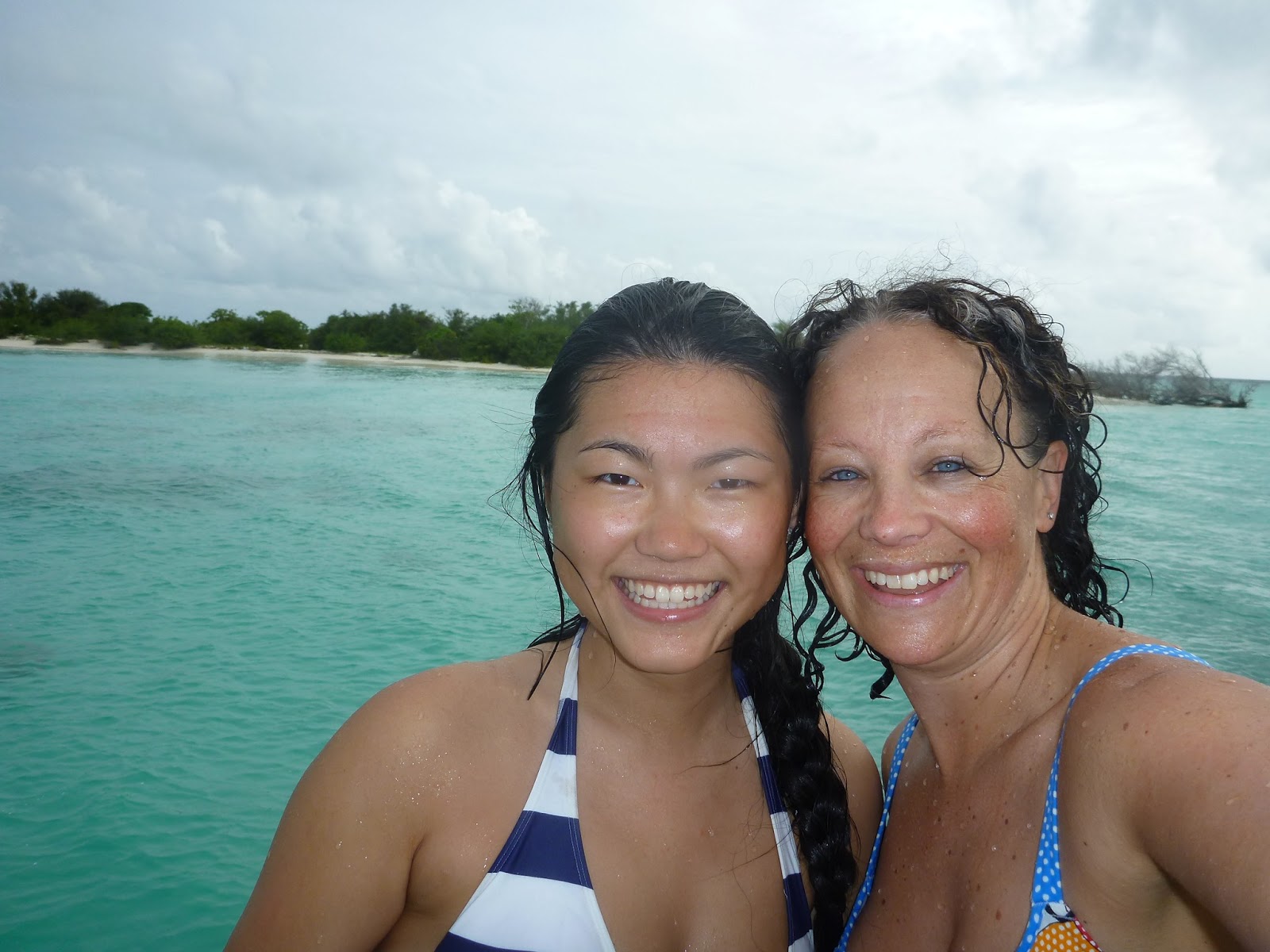
Vavvaru Island is only about 20 minutes away so the boat ride was thankfully calmer than my last trip. As soon as we were out of close range, extra layers came off and I could enjoy the direct sunlight on my pale skin. 

We anchored in close to the island and jumped off into the calm aqua waters. Coral, coral and more coral! Heaps of different species stretching out in long reefs. It was only a metre or so deep, then as we neared the edge, it dropped off down into the murky depths. Patchi is a talented free-diver and disappeared from sight, finally reappearing after holding his breath for what seemed like minutes. I have a whole lot of practice ahead of me if I hope to be even half as good as him at this sport.


There is quite a lot of plankton in the water this time of year so  it's not crystal clear. Still, I could see a good 7-10 metres or so and could happily snap away  pics of all I saw. 


There are mostly hard corals around Vavvaru. We'll be doing coral surveys so I'm curious to see how many I can name by the end. There were a few small clams, their bright speckled blue inner flesh sticking out into the sea. Patchi pointed out the only anemone we came across, it's soft tentacles waving gracefully in the currents and orange nemo fish darting in and out.


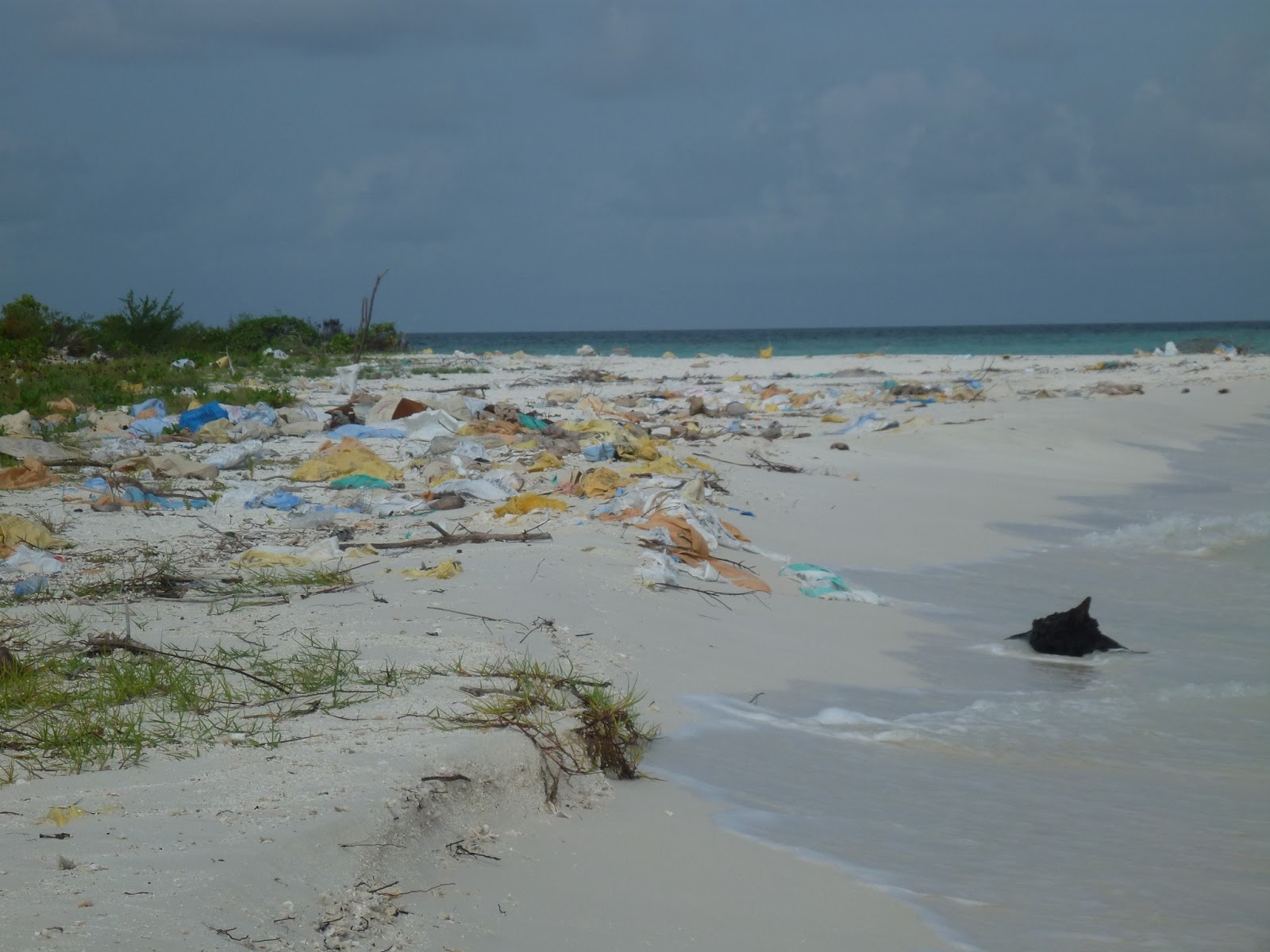
The current was slow and swirled us around the island, allowing us to move along the reef and see how it changed. More sediment was covering the coral on the sheltered side of the island and the coral seemed more damaged here. There is also a lot of rubbish in the water. We came across nylon sacks (used for sandbags) stuck around the coral and had a delicate task of trying to untangle them without destroying the coral in the process.

There were small schools of time reef fish hanging around their favourite coral, with larger fish slithering under rocks and overhangs whenever I got near.


After an hour or more, we climbed out and wandered back along the beach. Orange hermit crabs peer out of their pure white shells and scuttle away or hide whenever I came near. If I waited, they would eventually stick their heads out and begin to move again. And more rubbish, rubbish, rubbish washed up on the shore.


Cara and Megan

Patchi
A 20 second walk got us to the other side of the island. I was greeted by a white sandy beach, no coral reefs in close and gentle waves. We spent the next hour or so just swimming, chatting and relaxing in the warm tropical water.

A wander along this stretch of beach revealed even larger piles of rubbish washed up on the shores. Plastic and glass bottles, jandles, string and rope, cigarette packets, thousands more nylon sacks and tins. All covering the beach above the high tide mark. It was sad to see such a beautiful island so smothered and it feels like an insurmountable problem. 

How do you stop people throwing rubbish into the ocean when that is the norm and has been for years? One of the goals of Atoll Volunteers is to try and change these behaviours and so regular beach clean-ups and educational talks are some of the other things I'll be getting involved in too.